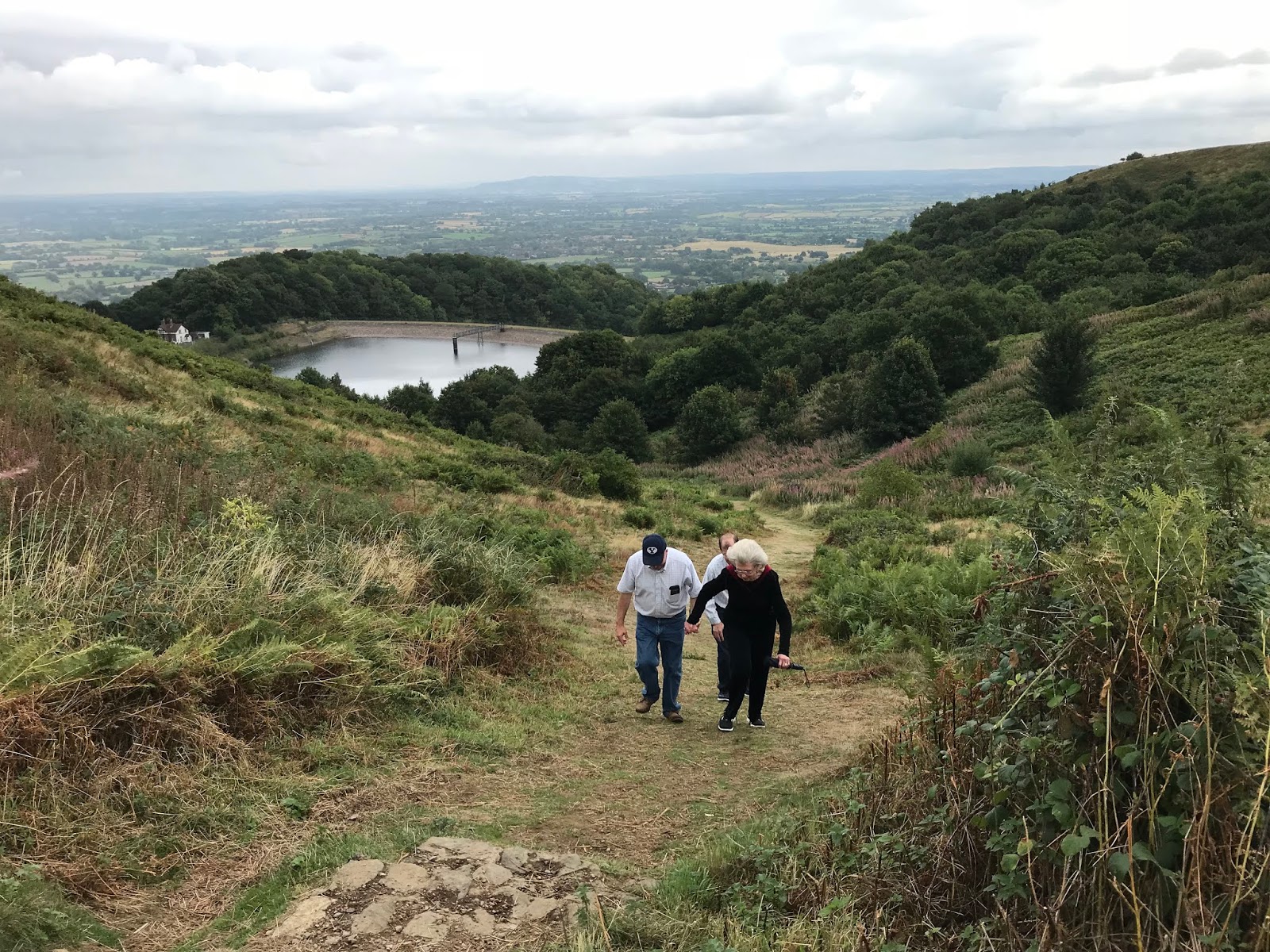
August 14-21, 2018 - Goodbyes, Myths and Church History Sites
We have a monthly Family Home Evening with the other temple workers who are on our shift which includes both full-time and periodic workers. The Rogers (Nigel and Denise) had the activity (this was their third and final time) which was a group trivia game. Here's what it looked like. Obviously old people are easy to entertain : )
 |
| Our FHE Trivia Game Team consisted of Brother and Sister (Brian and Penny) Wade, Elder and Sister (Raul and Karen) McQuivey, Elder and Sister (Ron and Brenda) Lindford and Elder and Sister Burkinshaw. Elder Burkinshaw was scribe and while we got all the science and history responses correct, we fell short on popular music and movies. |
On Friday, August 18, following our shift about 3:30pm, we went to the Chatham Historical Docks near where our "Ministers" (formerly home teachers) Nigel and Denise Rogers live. Unfortunately the docks had closed by the time we arrived because M25 which is the beltway that surrounds London was experiencing heavy traffic. The joke here is that M25 is the world's largest car park (parking lot). However, we did get to visit the Cadbury Factory Shop, where we took advantage of bargain prices on their dark chocolate! We also had a delicious Chinese Buffet at "The Real China."
 |
| Sister Burkinshaw and Sister McQuivey pose in front of the Cadbury Factory Shop. Yum! |
 |
| Elder Burkinshaw doesn't mind shelling out a few pounds for some delicious Cadbury chocolate. |
 |
| Our group of temple workers took up three tables at "The Real China" Chinese Buffet. Note that the plates were piled high! We can keep up with the young missionaries!! |
Alan and Ann Woolnough are members of the Addlestone Ward, which we attend each Sunday. For some time, they have tried to arrange lunch for us in their home and since this was the last Sunday that the Page's, who also attend Addlestone Ward with us, would be there, we had lunch with them. Alan recently received a pacemaker and Ann lost her left leg about 8 years ago when surgery for a knee replacement went awry, so they have had their challenges. However, they have been faithful members of the church for over 50 years and during our last testimony meeting, we heard several long-time members comment on the influence Alan had when he served as the Young Men President and Ann had as the Primary President. We had a delicious lunch and an opportunity to hear more about their lives and their children. Ann was one of the children who were evacuated (sent to live with another family in a safer area) during the war. They are a wonderful couple.
 |
| Sunday Lunch at the home of Alan and Ann Woolnough who are members of the Addlestone Ward where we attend. This is Elder and Sister Page's last Sunday there. It was a delicious lunch and very fun, interesting and faith-filled discussion as well. |
 |
| These are the small porcelain curios that Ann Wolnough has collected over the years. |
Following our lunch with the Woolnough's, we had to dash back to the Temple, where we participated in the "Hi and Bye" meeting for the arriving temple workers and the departing temple workers. Sister Burkinshaw plays for the London Temple Choir and Sister LuAnn Wolsey is the director and we sang an arrangement of Nearer My God To Thee during the meeting. The experiences of the incoming and departing workers are always impressive and remind us that we work with some of the very elect.
 |
| The departing Temple Workers with the Temple President and Matron. From left to right, Brother Ed and Sister Linda Kelly (Duston, Northampton, UK), President Mike and Sister Cathy Otterson (Farmington, UT), Sister Teri and Elder Clyde Page (South Jordan, UT) and Sister Denise and Brother Nigel Rogers (Gillingham, Kent, UK) |
A couple of weeks ago while visiting with some of the British temple workers they commented about early members who would threaten their badly behaving children with the "Mormon tunnel". Here is a little history behind the myth, along with some statistics that show that at times whole congregations, i.e. communities, migrated to the US.
Early Mormons in England faced persecution by civilians even as they were largely left alone by the state. Mormons first came to England in 1837, just seven years after Joseph Smith founded the Church in Fayette Township, New York. The first group of seven missionaries landed in Liverpool, and quickly began converting local citizens; they gained 50 new members in less than a month. In the ensuing years, more Mormons, many with English heritage, came from North America to England. They included recent English immigrants to Canada who wanted to return to their home country to expose their extended families to their newfound faith.
Anti-Mormon pamphlets—many of them distributed by Church of England clergy—surfaced within a year of the seven missionaries’ arrival. Soon, a “flourishing industry of anti-Mormon literature, and later, anti-Mormon films” developed said Craig L. Foster, a LDS historian of early anti-Mormon writing in Britain.
Some of the literature contained well-argued analysis of Mormon doctrine. But many of the pamphlets espoused falsehoods and stereotypes about Mormons, such as the notion that they had come to England to steal money. Another major theme was that Mormons wanted to take English women back to Utah for marriage, an accusation that intensified after the LDS Church publicly admitted in 1852 that its members practiced polygamy (a practice the Church renounced in 1890).
Some of the allegations about kidnapping English women verged on the absurd. In the late 1800s a myth began to circulate in Europe that Mormons had built a tunnel to traffic young English virgins to polygamist families in Utah. The tunnel started in Liverpool and continued beneath the American continent to empty into the Salt Lake Temple, where the virgins would be immediately deflowered. News of the tunnel supposedly got around after an English woman jumped out of the window of the Temple into the Great Salt Lake (which is 20 miles away), swam to freedom and lived to tell her tale. Foster said that he heard the myth repeated as recently as 1980 in Belgium, where he was serving a mission.
Myths aside, the LDS Church was indeed in the business of bringing people from the U.K. to Utah in order to fortify its fledgling base. According to David M. Morris, co-founder of the European Mormon Studies Association, by 1852 there were 32,894 Mormon converts in Britain, “more than the rest of the worldwide Church combined.” By 1900, that number had shrunk to 4,183. “A large portion of these migrated to America to be with the main body of the Church in Utah.”
This myth most likely started because of the events that took place in the area of England that we visited this week for preparation day.
We loaded up both vans this week and drove three hours north to visit The Gadfield Elm Chapel near the village of Pendock in Worcestershire, England, Hill Farm and Benbow's Pond and climbed The Herefordshire Beacon Hill. The following is a little History of how the work in this area began:
Wilford Woodruff could not help but wonder what would be the effect of the inspiration he felt that March day in 1840, during his first mission to England. He and Elder Alfred Cordon were already having some success at their missionary work in the Staffordshire Potteries district. But the voice of the Spirit was telling him to go elsewhere.
In February of 1873, he recalled: “I went one evening to fill an appointment at the town hall, in the town of Hanley. There was a very large congregation, and I had appointments out for two or three weeks in that town and adjacent villages. As I went to take my seat the Spirit of the Lord came upon me and said to me, ‘This is the last meeting you will hold with this people for many days.’ I was surprised, because I did not know, of course what the Lord wanted me to do. I told the assembly when I rose, ‘This is the last meeting I shall hold with you for many days.’ They asked me after meeting where I was going. I told them I did not know. I went before the Lord in my closet and asked him where he wished me to go, and all the answer I could get was to go to the South. I got into a stage and rode eighty miles south, as I was led by the Spirit of the Lord.”
This response to inspiration initiated one of the most fruitful missionary journeys in the history of the restored Church. President Woodruff spoke of the ensuing months in Herefordshire as one of the highlights of his life. He rejoiced in the revelation that called him there, always acknowledging the hand of the Lord in the rich spiritual harvest he helped gather.
So follows pictures of our adventures to these three sites. The landscape was stunning and the realization of those that sacrificed much was evident in the spirit that was felt.
 |
| A map showing the British Church History sites we visited (upper left-had corner) which also shows London. It was about a 3 hour drive from the London Temple. |
 |
| On our trip, we made a rest stop at one of the "Services" along the M25 motorway for treats. Sister Carla Haines (San Tan Valley, AZ) had a Krispy Kreme donut and Elder Burkinshaw has some carrot sticks (under the guidance of Sister Burkinshaw! ;-) |
 |
| A close-up map of the British Church History sites, showing they were in the area of the Malvern Hills, which are very pretty despite the dry summer we have had here. |
 |
| A sign pointing the way to the Gadfield Elm Chapel |
 |
| This picture shows the fields near the Gadfield Elm Chapel, which is far from any real village or town. |
 |
| The entry doors to the chapel of the Gadfield Elm meetinghouse. |
 |
The Gadfield Elm Chapel was built by the United Brethren in 1836 and deeded to the Church in 1840. It was the first building to be owned by the Church in England and one of the first chapels ever owned by the Church. Brigham Young preached at Gadfield Elm twice, once on 17 May 1840 and once on 14 December 1840.
|
 |
The Gadfield Elm Chapel acted as the focal point of Church activity for thousands of Latter-day Saints. Around 1842, as many converts began to immigrate to the United States, the chapel was sold to help fund their journeys. Over the next 150 years, the chapel was used as a toolshed, a garage and a home, eventually falling into disrepair. In 1994, the property came up for auction, and a group of local Latter-day Saints joined together as the Gadfield Elm Trust to raise money to purchase and restore the building. This group then donated the building to the Church in 2004. Then-President Gordon B. Hinckley (1910-2008), traveled to England to accept the building as an official Church historic site.
|
 |
| The Gadfield Elm Chapel Plaque. |
 |
| Fields and farms surrounding the Gadfield Elm Chapel. |
 |
| Temple workers looking over the grounds and the plaques at the Gadfield Elm chapel. Note the picnic tables in the field, it was a little early for lunch though. |
 |
| Elder and Sister Burkinshaw in front of the Gadfield Elm Chapel. |
 |
| The plaque summarizing the history of the Gadfield Elm Chapel. |
 |
| A view of the door to the small visitors center, complete with Christus statue, at the Gadfield Elm Chapel. |
 |
| Looking towards the back of the chapel in the Gadfield Elm Chapel meetinghouse. |
 |
| Looking towards the front of the chapel in the Gadfield Elm Chapel meetinghouse. The supporting beams were very impressive for this exceptionally tall building for the period. |
 |
| The pews in the chapel are not original to this meetinghouse but are from the same time period and were purchased from another old church in Wales to give a feel for what the chapel may have looked like during the 1840's. |
 |
| The chapel had two large windows looking out on the fields in the area. |
 |
| Elder and Sister Burkinshaw with an obligatory selfie in the Gadfield Elm Chapel. |
 |
| A picture of our group for this tour of the British Church History at the Gadfield Elm Chapel. Sister Burkinshaw played the organ and we all sang "How Firm a Foundation." |
 |
| Elder Orr selfie (he didn't want to be forgotten) from Oklahoma City (OK City South Stake) was spending his P-Day visiting the Gadfield Elm Chapel was kind enough to take the group photo. He knows Jourdon Bean, who served with us in the Brasil Vitória Mission. |
NEXT STOP: BENBOW FARM
 |
| Originally called Benbow Farm, this is currently Hill Farm. It was here that William Benbow, a convert of Elder Wilford Woodruff near Preston, led Elder Woodruff to meet his brother and sister-in-law John and Jane Benbow. |
 |
| Sister Burkinshaw in front of Benbow (Hill ) Farm. John and his wife Jane were originally members of the United Brethren and they were introduced to the Mormon faith by Wilford Woodruff. Wilford arrived at Worcester in a horse-drawn carriage and then he walked the fourteen miles or so to the farm at Castle Frome, to talk with John and Jane Benbow. A religious revival, which at the time was a huge event, was held in a barn at Benbows Farm; at three meetings that day, over a thousand people went to hear the message of Wilford Woodruff. |
 |
| Adjacent to Benbow Farm are fields with sheep. This made our walk to Benbow Pond somewhat hazardous ;-) |
 |
| This is the plaque placed in front of Benbow Pond about a quarter-mile from the farmhouse. |
 |
| As you can see, Benbow Pond was more like Benbow slough because of the dry summer. The light green in the center was actually water with a lot of algae. |
 |
| Elder Burkinshaw in front of Benbow Pond where hundreds of converts from the United Brethren were baptized. The historical record stated that even at that time, they had to clean out the pond for baptisms. |
 |
| Here is another picture of Benbow Pond during the spring which shows that it was indeed a pretty and functional location for the many baptismal services held here. |
 |
| Our group of Temple Workers in front of Benbow Pond. |
 |
| Sister Burkinshaw caught a candid photo of Elder and Sister Lindford smooching in front of Benbow Pond (Sister Wolsey is the photographer), Elder Burkinshaw in deep conversation with Elder Guenther and Elder Wolsey and Sister Otterson (yellow shirt) taking a picture of President Otterson. |
NEXT STOP: LUNCH IN LEDBURY
 |
This marketplace in Ledbury, Herefordshire, was the scene of missionary activity as well as commerce. Wilford Woodruff visited the town many times while working with the United Brethren. Brigham Young spent a week in the town and directed others to find him from this marketplace. We had lunch here during our excursion.
|
NEXT STOP: HEREFORDSHIRE BEACON
 |
| Sister Burkinshaw took this photo of Elder Burkinshaw helping Sister McQuivey hike up the very steep paths of Herefordshire Beacon, the tallest hill in the area. |
 |
| A view looking west from the top of the Herefordshire Beacon. |
 |
| Looking northward from the top of the Herefordshire Beacon. |
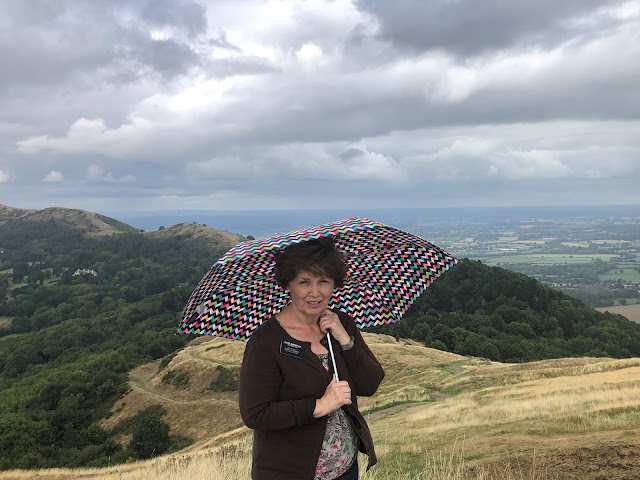 |
| Sister Burkinshaw trying to keep the umbrella up with a strong wind and light rain on top of Herefordshire Beacon. |
 |
| A panoramic shot looking east from the top of Herefordshire Beacon. |
 |
| A panoramic shot looking west from the top of Herefordshire Beacon. |
 |
The view from atop the Herefordshire Beacon (Malvern Hills), the site of both a pre-Roman British fortress and a Roman fort. Wilford Woodruff went there to pray on several occasions. On 20 May 1840, he, Brigham Young and Willard Richards met there and decided to print the Book of Mormon and a hymnal with funds donated by John and Jane Benbow and Thomas Kington.
Using Family Tree "Map My Ancestors" we discovered our closest relative to this area was John Abraham who would be Sister Burkinshaw's great, great, great Grandfather born in Bleevavon, Llanover, Monmouthshire, England and buried in Abersychan, Monmouth, England which is about 17 miles southwest of where we were visiting. Under "Memories" for John Abraham in FamilyTree, there is an interesting personal timeline sharing his life history. A similar timeline is included for each prophet in the Teachings of the Prophets manuals. Elder Burkinshaw has also done a similar timeline for us.
An interesting comparison of John Abraham's family with the family of Joseph and Emma Smith are the number of children they had and the number of children that lived to adulthood.
"At death of John Abraham it should be noted that John & Elizabeth had eleven children but only three of them grew to adults & were able to have decedents. James & Griffith (our line runs through Griffith) married and brought their families to the United States. Moses married and lived his life in either Wales or England. The Abraham family were Colliers (coal miners) working in the iron works in Wales under very harsh conditions and as a result, many of the children in the family did not survive." (Memories, John Abraham, FamilyTree)
"Of the many hardships Joseph Smith Jr. and his wife Emma endured, the one that was perhaps the most difficult, especially for Emma, was losing so many of her precious babies. Only 5 of her 11 children lived past the age of 2, and her only biological daughter died at birth. After her husband was killed in 1844 and the majority of the Saints moved West, Emma was left in Nauvoo to raise their surviving children alone." (LDS Living)
We are so grateful for our children and grandchildren and to be blessed to live in a time when childhood mortality is not one of the challenges we face.
Love to all,
Elder and Sister Burkinshaw
|