Monday, July 29, 2019

July 2019: Pioneer Day and Sheffield Park

As is tradition here at the London Temple, we celebrate Pioneer Day on the Monday before, which happened on July 22nd. Brother and Sister Littlefield from North Carolina brought a 10 year tradition with them and served sourdough pancakes complete with maple syrup, Nauvoo butter syrup, strawberries, blueberries and cream and they were delicious. We have included the recipe for the pancakes as well as the Nauvoo butter syrup and our traditional London Temple ordinance worker photographs on the East stairs. (The stairs will be replaced with granite stairs during the August shutdown).

Sourdough Pancakes (Seriously these are the best pancakes we have ever tasted - and we know pancakes!)
To make sourdough you need to have a starter. You can save a starter from a previous batch or you can make a starter each time pancakes are made. A starter will not last for a long time, so if you do not make pancakes every 2-3 weeks it is best to make a starter each time.

To make the starter:
I like to use bread flour. The British Strong Flour worked really well. The high level of gluten made the yeast work really well. In any case it must be all purpose flour.

1 cup all purpose flour
1 cup water 
1 package yeast

Directions for starter:  Mix together in a small glass or plastic bowl. Cover with plastic wrap (cling film) or foil but don’t seal. Let it sit out at room temperature for 3-4 hours before you are ready to make the mix. It will get bubbly and it may thin out as it works.

To make the mix:
Make this the night before for breakfast or 5 or so hours before you want to eat in the evening. I have always thought it best to make it in plastic or glass bowl, not metal. I don’t know why except my mom told me that. Mom was usually right.

2 cups flour (see note about flour above)
1 teaspoon salt
3 tablespoons sugar
2 cups of milk  (I have always used powdered milk and added water to make 2 cups, I had a failure once using milk, but I have also had successes. I have made it using Almond milk and it worked fine to make non-dairy pancakes)

Directions: Mix the above and add the starter. You can add about half of the starter or all of it to make a little more batter. Cover loosely with foil or plastic and sit out at room temperature until you are ready to finish the mix. This will grow, so make sure you have plenty of head space. I always like to set the container somewhere so if it overflows it will not hurt anything. 

To finish making the pancake batter:  *(If you want to keep a starter for the next time, remove about half a cup before you add the eggs and oil, place in a covered container, and keep refrigerated).
Now beat together 2 eggs and 4 tablespoons of oil and add to the mix.
Add 1 teaspoon baking soda to the batter and stir well.
The batter will rise a little as the soda reacts to make bubbles. Let it sit for a few minutes before cooking. Then spoon on a hot pan or grill and turn when bubbles form and a few stay open. Cook to golden brown.

This will serve about 4-5 people. For a large group you can multiply many times. But the starter does not need to be made larger. You can freeze leftovers and microwave to serve.


Nauvoo Butter Syrup
1 cup butter
1 cup buttermilk
2 cup sugar
1 teaspoon baking soda
1 teaspoon vanilla

1 teaspoon maple flavoring

Directions:
Bring first three ingredients to a boil for 2 minutes. Remove and add the remaining ingredients. Make sure it is in a large pot-- the soda will make it froth up. I have also used reconstituted butter milk powder and it tastes just as good. Serve on pancakes or waffles, it has a great caramel/maple flavor. YUM!


July 22, 2019 Temple ordinance workers photograph on the East stairs of the temple. From left to right and bottom to top by couples are: Linfords, Russ', Dodkins, Thompson's, Fitzners, Sharlands, Sister Haines, Sister Peel (President Peel was the photographer), Littlefields, Turners, Ruses, Davenports, Sister Docherty, Lloyds, Freemans and the Burkinshaws. President and Sister Otterson are front left.

The Sisters - Sister Burkinshaw is on the back row, maybe a little to close to Sister Freeman.

The Brothers - Elder Burkinshaw is should have switched places with President Otterson, but we don't make a habit of telling the temple president what to do or where to go (arr, arr).

Just added this one because of it's humor. Sister Burkinshaw didn't make it in time, but Brother Thompson (2nd from the right on the back row) stepped in for her--although he has a way better tan as they recently arrived from Arizona.


Sheffield Park
Sheffield Park Garden is an informal landscape garden in East Sussex, England. It was originally laid out in the 18th century by Capability Brown, and further developed in the early 20th century by its then owner, Arthur Gilstrap Soames. It is now owned by the National Trust.  The original four lakes form the centrepiece. It is particularly noted for its plantings of trees selected for autumn colour, including many Black Tupelos.  During World War II the house (privately owned) and garden became the headquarters for a Canadian armoured division, and Nissen huts were sited in the garden and woods. The estate was split up and sold in lots in 1953. The National Trust purchased approximately 40 ha in 1954, now up to 80 ha with subsequent additions. It is home to the National Collection of Ghent azaleas.

The park is about a 30 minute drive from the temple and a National Trust property so we drove on Preparation Day, July 29th for a look and were very impressed with what we saw. The pictures of course do not do it justice and we will definitely have to go back one more time before we leave to hopefully see the Fall colors. We also found a new dairy farm that opened an ice cream shop on the way home and that was delicious. They make the ice cream on site as well as sell milk. They also put hot fudge in the bottom of the waffle cone before they put the ice cream scoops on and that was amazing!
One of four lakes at Sheffield Park. This one had amazing lily pads. Lily pads provide an important hiding place for frogs, which are susceptible to underwater predators such as fish and water snakes. ... The shade also limits the growth of algae, which might otherwise bloom excessively, leading to decreased dissolved oxygen levels in the water. Water lilies were used to treat a variety of ailments. When mashed, the roots created a poultice that reduced swelling. These poultices were also used to treat reproductive problems in women, and also as a mouth rinse.

Giant Redwood/Sequoia tree. This tree is just a youngster at around 140 years old, as Sequoia ca live up to 3000 years. It is one of the tallest trees in Sheffield Park at over 30 meters and will continue to grow. This is the one tree in the garden that they encourage visitors to play on, Sister Burkinshaw elected to just have her picture taken with it.

Sister Burkinshaw in front of the Lake with the Sheffield House in the background. The house has been and remains today a private residence.

Elder and Sister Burkinshaw doing the selfie thing.

One of the larger lakes at Sheffield Park.

The bridge and water steps between two the lakes at Sheffield Park.

Sister Burkinshaw in front of another of the very large trees in Sheffield Park, this would be a great climbing tree.

Mission Call - As we have not quite decided where to retire and our belongings are safely stored away, we felt impressed to submit our papers to serve another mission - this time for a year. We requested the Family History Center in Salt Lake City as we are anxious to spend more time on family history research and Salt Lake had a lot to offer both in training and resources and good places to have lunch ;-). Our call came back to serve in the Salt Lake City Temple Square Visitors Center so we will have to spend our free time honing our family history research skills. We will however still be able to enjoy all the resources available in downtown Salt Lake City.


Temple Grounds and Temple Stories
For most of the time we have been here at the temple this area has been a construction site. The water boilers and piping which heats the temple had to be replaced and a project projects to take 3 months took over a year, in part due to the bankruptcy of the original contractor. The sod was quickly laid the first of June when heavy rain was forecast. As you can see the timing was perfect and grass and new shrubs have done very well.

The summer flower beds across from the new grass which have also done great this year because of all the rain we have had - very different than last summer.

The flower beds on the East side of the temple with the a view of the steps. The steps will be replaced during the August shut-down. They are made of sandstone and have not worn well. The new stairs will be granite.

We have submitted the following story to the Ensign magazine as it is quite remarkable. Brother Whitehouse told us this story on a van trip early in our mission and we had asked him if he would write it down so we could share it with our family. He was finally able to do so and gave it to us a couple of weeks. 

Ann Whitehouse's Miracle
by Jim Whitehouse

In the autumn of 2003, I was a detective in Special Branch, the Security arm of the British Police Force and Ann, my wife, was a supply teacher.  We lived in Chandlers Ford, Hampshire.  Our children were grown up, married, at University and College, and our daughter Sarah was serving a mission in the Belgium/Netherlands Mission.
Ann had visited her mother 150 miles away and I remained at home with our youngest son Edward who was attending college. 
About five in the afternoon, I received a telephone call from Ann’s mother.  Ann had collapsed and was in hospital. 
Eddy and I drove quickly to the Midlands to find Ann in Walsall Manor hospital barely conscious.  The doctors were hardly forthcoming, telling us that they were doing tests, but had no idea what was wrong.
We waited, and waited and waited.
Three days later, the situation had not changed.  The test results had either not come back yet, or were inconclusive. 
Five days later a unsympathetic doctor told me that my wife had terminal cancer of some sort and had but two or three days to live.  No kindness, no hope – just the facts and learn to live with it!
Almost forcibly I prevented her telling my wife there and then.  If she had to know, I would tell her. 
I asked, “Were all the test results in?”
“No,” she responded but it was a foregone conclusion.
I told her, “When all the results were in and it was a certainty, then I would tell Ann.  What tests were to come?”
She said, “Only the x-ray which would determine where the cancer was seated.  Any attempt at treatment was a waste of time and money.”
I said, “Where are the test x-rays held?”
“They are here, at the hospital but they are not easily interpreted.  A specialist will look tomorrow morning” she replied.
I was left alone.  Desperate I asked the nurses “Who is this specialist? Is he on duty?” By now it was seven-thirty in the evening. The nurse replied “It is Mr. ____ and by chance he is the duty specialist tonight.”
Eventually I found him and I badgered and browbeat him until he found Ann’s x-rays and examined them.
They were head-to-toe pictures from many angles and he slowly looked at them.  Then he looked at them again.  He looked a third time… then a fourth and a fifth time. He scrutinized the pictures, I scrutinized him through the glass of his office door
Eventually he mounted all the x-rays on viewers around his room and said, “Your wife’s problem is situated in her head, where it is attached to the spine.  Cancers cannot grow of themselves in the head.  They grow elsewhere in the body and are carried to the head.  She has some form of tumor, but there is absolutely no sign of its origin.”
I said, “So she has not got cancer then?”
“I cannot find one anywhere.” Was the reply
I asked, “So what is it?  Do we have hope?”
“I don’t know what it is.  I would not say hope but certainly a reprieve.”
From that moment on, things began to change.  Ann was transferred to one of the top neurological hospitals in the country…to die they thought…to live we hoped and prayed.
By some chance, the team treating Ann found a medicine that had a profound effect on her condition – steroids!  By law in the UK, doctors undertaking normal treatment are only allowed to small doses of steroids to a patient.  This is because of the dangerous side-effects the drug produces on the body.
Ann was given a large doses of steroids twice-a-day, by injection.  The reasoning was simple: Ann is going to die – very soon – so she would be dead before the side-effects could ever manifest themselves, but in the meantime, she would be conscious and have a better quality of life – for what was left of it.
Treatment continued and Ann remained conscious for longer and longer periods and after a while she could shower, dress and walk around the ward.
She remained in the Terminal Ward and it was heart-breaking each visiting time to see another empty bed, or miss a familiar face.  It was bad enough for Edward and me when we visited.  I shudder to imagine what it was like for Ann.
Whilst we were away, up in the Midlands it was Stake Conference and Edward was sustained an Elder.  We received the news by telephone and my elder son John and I ordained Edward to the Priesthood in the hospital next to Ann’s bed. 
Immediately afterwards, we administered to Ann in her hospital bed.  Edward anointed with his newly consecrated oil and John sealed the anointing and pronounced a blessing.  I took part but said nothing – I know what I would have said, but would it have been the will and word of the Lord?
John told his mother that she would recover, but the road would be long and hard. 
That is it, then!  
No problems now.  We know what is going to happen, do all that we can, trust in the word of the Lord and just endure in good works to the end!
We worked hard on that principle and Ann showed gradual improvement until after some weeks she was fit enough to be discharged. 
Overjoyed, we drove the 120 miles home.  The hospital had arranged a follow-up appointment at our local hospital that also had the reputation as a top neurological hospital.  All was going well.
Then, all reversed itself!  Two days before her appointment, Ann collapsed and was rushed into hospital again.  All the same tests.  All the same conclusions.  All the same predictions. 
The specialist took me to one side and told me they thought Ann had cancer, but they could not find it in her body.  Her condition deteriorated. They transferred her to a single room to die in solitary privacy (they said). 
I looked up what they told me Ann had in the local library.  There were eleven symptoms.  I asked for an appointment with the specialist
We met.  He repeated his diagnosis, with much regret and far more delicacy than the previous bearer of bad news. I told him I thought he was wrong.  He was taken aback but polite.  Why did I disagree with him?  Was I a doctor?  How did I know when he did not know?
Of course, I wasn’t a doctor, in fact I had given many doctors much work in my chequered past.  However, I was very good at reading and when he told me what he thought Ann had, I looked it up in the library and checked the facts.
He snorted, a little affronted, very well how many symptoms were there for the cancer Ann had (he thought she had)?
“Eleven”
“Oh! That’s right.  And...?”
“They are….” I reeled them off.
“That’s right too.”
Furthermore Ann has only four of those eleven symptoms.
Well yes, but the others could soon develop.
If they do, it will be very unusual according to the book I read.
Yes, well, we are conducting further tests and when we get the results, I will tell you.
He was not used to being questioned, especially not by an unqualified detective and was surprised I had taken the trouble to look it up.  He was even more surprised when I understood what I had read and looked for the signs in my wife.  Desperation?  No I am just that sort of person – never trust anyone and you will never be disappointed.  Anything else is a nice surprise.
A day later, further test results were in and whatever the doctors thought it was – it wasn’t.
More steroid treatment, more improvement, until one day Ann could go home.  There was a price to pay:
Insulin injections four times a day.  Steroid tablets twice a day, tablets to counter the effects of the steroid treatment four times a day.
In all twenty-nine tablets twice a day, four injections a day.  Little sleep, bedridden, nightmares when she did sleep, anxiety and boredom when she didn’t.
I would lie awake in the small hours listening to her breathing wondering if or when it might stop.  Often when I fell asleep, Ann would have nightmares kicking and screaming in her sleep, lashing out, fighting away who knows what demons – she hardly ever remembered her dreams on waking.
For eight years this continued, bedridden for many of them then wheelchair bound.  Regular visits to the specialist to hear the same old news: “You will never improve.  You will take steroids for the rest of your life.  Your life expectancy has been dramatically reduced by your illness,” and so on.
One bright, sunny, late spring morning, Ann was in very low spirits.  Bored to tears she was, in her word, “Fed up!”
Inspiration struck! “Let’s drive to the Temple.  We can’t go in but it will be a pleasure just sitting in the grounds.”
Off we went.  It was beautiful.  Flowers bloomed, the fragrance of freshly cut grass and bright sunlight restored our spirits. 
We stood at the foot of the entrance steps looking up and a worker, no - an angel, standing inside saw us.
“Are you members?”
“Yes”
“Do you have current recommends?”
“Yes”
“Well come on in”
“Well…”
In we went.  The questions were few but direct:  “Are you going to go on an Endowment Session?”
“Ann can’t – she cannot manage on her own.”
“Oh, don’t worry about that – we will help.  Come on, let’s get started!”
I don’t remember any of what transpired, but we did it.
At home that evening we agreed it had been a wonderful day.  There was a noticeable change in Ann.  We made a firm commitment to go on a monthly basis.  We aimed to never miss a month.  If we did then we made sure that we went twice the next month.  We found friends to go with us.  Always on a Friday evening, always the 9:00pm session. They supported us making sure that if we were down they lifted our spirits and our desire to go. Real friendship is like that.
Ann graduated from wheelchair to walking frame, walking frame to two walking sticks, two walking sticks to one and then to none!
Her medicine followed suit.  From injections to tablets, from steroids to steroid substitutes – each change of medicine followed with the cautionary, “This is the last change of prescriptions, and you cannot endure any lower dose!” 
But Ann did.  Lower and lower until there was nothing to take.  Patient discharge loomed larger on the horizon.  Loomed.  Came and went.
All of the time we kept up our monthly Temple visits each time becoming more sensitive to the Spirit, anxious to gain further light and knowledge – and we did.
Eager to repay the Lord for the blessings He showered upon us, we became periodic Temple workers.  In 2014, beginning in January, we worked one month at the London Temple, one month at home.  By August of that year, Ann wanted to work full-time and this we started in January 2015.  We have done so ever since.

Jim Whitehouse currently serves as an assistant recorder in the London England Temple and his wife Ann serves in the Temple Office.

In conclusion, we quote from President Russell M Nelson, who said:

“My dear brothers and sisters, construction of these temples may not change your life, but your time in the temple surely will. In that spirit, I bless you to identify those things you can set aside so you can spend more time in the temple. I bless you with greater harmony and love in your homes and a deeper desire to care for your eternal family relationships. I bless you with increased faith in the Lord Jesus Christ and a greater ability to follow Him as His true disciples.” (Russell M Nelson, "Let Us All Press On." General Conference, April 2018)

Elder and Sister Burkinshaw

Wednesday, July 3, 2019

July 2019: Isle of Wight and Portsmouth

We drove to Portsmouth and the Isle of Wight with Elder Marvin and Sister Stephanie Smith at the beginning of July to visit the sights there.  The weather was very nice.

HMS Victory
HMS (His/Her Majesty's Ship) Victory was taken out of service in 1812 and remained in Portsmouth Harbor until 1922, when the ship was moved to the Royal Naval Dockyard amid fears for her deteriorating condition.  The Admiralty Board ordered that the Victory should be preserved and Portsmouth Dock No. 2 was to be her home.


HMS Victory of the famed the Battle of Trafalgar (21 October 1805) where Lord Admiral Horatio Nelson led the British Navy to defeat the combine French and Spanish navies.  Napoleon had determined to invade Great Britain and to do so he needed to defeat the British Navy.  Utilizing 33 French and Spanish ships he engaged 27 British ships in the Atlantic Ocean off Cape Trafalgar Spain.  The successful battle strategy of Lord Admiral Nelson resulted in the the destruction of 22 French and Spanish ships while not a single British ship was lost.  This was the last serious challenge the British Navy would face.  

The back of HMS Victory.  Note the White Ensign, at one time called the St George's Ensign due to the simultaneous existence of a cross-less version of the flag, is an ensign flown on British Royal Navy ships and shore establishments. It consists of a red St George's Cross on a white field with the Union Flag in the upper canton.

The Battle of Trafalgar by JMW Turner which portrays the HMS Victory led by Lord Admiral Horatio Nelson.  The colored flags on the HMS Victory signal Lord Admiral Nelson's famous last command, "England expects that every man will do his duty."   

The statue of Lord Admiral Horatio Nelson at the top of the pillar in London's Trafalgar Square.  Lord Admiral Nelson personifies the dedication to duty and country that was a part of the British psyche.  In his country's service he had lost the sight in one eye and his left arm and in his most successful battle, the Battle of Trafalgar, he lost his life, shot by a French musketeer.


Emirates Spinnaker Tower
The Emirates Spinnaker Tower is a 560' tower built in 2005 as the centerpiece of the redevelopment of Portsmouth Harbor.  It is named after a spinnaker, a type of sail that balloons outward.  It is the center of a very nice shopping mall with many nice restaurants.


Emirates Spinnaker Tower amidst the beautiful shopping mall at Portsmouth harbor.


The Emirates Spinnaker Tower from the Wightlink Ferry.  The tower represents sails billowing in the wind, a design accomplished using two large, white, sweeping metal arcs, which give the tower its spinnaker sail design.  There are three observation platforms. A glass floor is located on the first viewing deck at 100 meters above sea level.


Wightlink Ferry to the Isle of Wight
We had to schedule our ferry ride from the Portsmouth to the Isle of Wight a couple of weeks in advance and for the car and the 4 of us it was about £50 or $65.  We had to be there 30 minutes before departure and the trip took about 45 minutes.


Sister Stephanie Smith and Sister Burkinshaw in the Smith's car (they drove for this trip) awaiting to be loaded on the ferry.

The parking area which leads to the loading ramp on the ferry.

The MV (for Motor Vessel)"Victoria of Wight" WightLink MV which holds up to 1208 passengers and 178 cars traveling at 13 knots with a crew of 11 people.

The inside observation deck from the ferry.  It was too windy and cool for the outside deck.

Elder and Sister Burkinshaw on the observation deck with a Costa hot chocolate!

Isle of Wight
The Isle of Wight is the largest and second-most populous island in England. It is in the English Channel, between 2 to 5 miles off the coast of Hampshire. The island has resorts that have been holiday destinations since Victorian times (i.e. reign of Queen Victoria from 1837 to 1901), and is known for its mild climate, coastal scenery, and verdant landscape.  It is cited in the Beatles song When I'm 64 with the line, "Every summer we can rent a cottage in the Isle of Wight, if it's not too dear" which was appropriate since Elder Burkinshaw is 64!


Osborne House


A view of Osborne House, built between 1845 and 1851 for Queen Victoria and Prince Albert as a summer home and rural retreat.

The entry courtyard to Osborne House.  After Queen Victoria died in 1901, since the remaining royal family considered Osborne house a "royal white elephant" it was donated to the nation as a museum.

Queen Victoria, Prince Albert and their nine children at Osborne House on 26 May 1857. From left to right: Prince Alfred, Princess Alice, Princess Helena, Prince Leopold, Prince Albert, Queen Victoria holding Princess Beatrice, Prince Arthur, Victoria, Princess Royal, Albert Edward, Prince of Wales and Princess Louise.  The nine children married into royal and noble families across the continent, tying them together, earning her the nickname "the grandmother of Europe", and spreading hemophilia to several royal families.


Sister Burkinshaw at a display recognizing the importance of birthdays at Osborne House. From 1846 until Prince Albert’s death in 1861, Victoria and Albert were almost always at Osborne for their birthdays, on 24 May and 26 August respectively.  Central to their celebrations was present-giving, and many of the birthday gifts the royal couple exchanged are on display at Osborne house.

A statue of Queen Victoria dressed in classical Roman robes in the grand corridor at Osborne House.  The statue was commissioned by the Queen and presented to Prince Albert on his 30th birthday in 1849.  


Life-size statue of  Prince Albert in Classical armor at the top of the Osborne house stairs, a birthday present to the Queen on her 27th birthday in 1846. 

The Audience Room where Queen Victoria, as Head of State received statesmen and other official visitors.  The tinted glass and metal chandelier is in the form of a convolvulous flowers climbing from a basket.

The Family Dining Room.

A large painting depicting the Royal family.  Below it is a mahogany buffet which used to carry a boars head on Christmas day.

The drawing room with striking gold settee and a grand piano.  Queen Victoria usually retired here after dinner to play cards, sing, or play the piano.

The nursery as used by Queen Victoria's grandchildren on their visits to Osborne.  The fine swing cradle with its mahogany frame was made for the Princess Royal in 1840.

The Queen's Sitting Room where Queen Victoria worked on the state papers with Prince Albert in his role as her private and personal secretary.

In the Queens Sitting Room was a harpsichord and a painting that the Queen gave to Prince Albert for his 33rd birthday. 

Queen Victoria died in this bed at 6:30 pm on Tuesday 22nd January 1901, surrounded by her relatives.  Following the funeral, her children had the plaque placed above her bed and the room was used as a family shrine.  The plaque reads: "Thy Saviour called thee Beloved. Now thy work is done. Thou art weary.  Come Rest in the eternal Father's home.  In loving memory from her sorrowing children, grandchildren and great grandchildren to their dear beloved Mother and Queen Victoria.  January 22, 1901. 

A portrait of Queen Victoria in her bedroom.

The Durbar Room where Queen Victoria held great banquets in this, the most elaborately decorated interior at Osborne.

Finished in 1891, the Durbar Room was decorated in a rich Indian style as she was fascinated by the culture and wanted to bring something of India to her home.  The country had been under British control since 1858 and the queen was made Empress of India in 1877.  The name 'Durbar' comes from the Indian word for a state reception and a hall where such gatherings were held.

A place setting at the dining table in the Dunbar Room.  Note the overlapped V and A logo for Queen Victoria and Prince Albert.

The fountain and back courtyard of Osborne House.


Sister Burkinshaw looking at the 200th birthday garden for Queen Victoria and Prince Albert at Osborne House.

Panoramic view of the beach which was part of the Osborne House compound.  Note that it is a true sand beach as opposed to the gravel and pebble beaches along the English Channel such as in Brighton, Eastbourne or Dover.

Sister Burkinshaw took off her shoes to enjoy the sandy beach and the sea.

A shady retreat built for Queen Victoria, Prince Albert and their family when they played on the beach.

Osborne also had a 'Swiss Cottage' for the Royal children. The cottage was dismantled and brought piece by piece from Switzerland to Osborne where it was reassembled. There, the royal children were encouraged to garden. Each child was given a rectangular plot in which to grow fruit, vegetables and flowers. They sold their produce to their father. Prince Albert used this as a way to teach the basics of economics. The children also learned to cook in the Swiss Cottage, which was equipped with a fully functioning kitchen. Both parents saw this kind of education as a way of grounding their children in the activities of daily life shared by the people in the kingdom despite their royal status.

Carisbrooke Castle
Carisbrooke Castle is a historic motte-and-bailey castle located in the village of Carisbrooke on the Isle of Wight.  A motte-and-bailey castle is a fortification with a wooden or stone keep situated on a raised earthwork called a motte, accompanied by an enclosed courtyard, or bailey, surrounded by a protective ditch.  While Carisbrooke dates back to Roman times in the 5th century, the walls and first building were constructed around 1000 AD.  From 1896 to 1944, it was the home of Princess Beatrice, daughter of Queen Victoria, as Governor of the Isle of Wight.


The gatehouse entrance to Carisbrooke Castle.

Some of the ancient walls of Carisbrooke Castle dating to 1000 AD.

A vista of the walls and structures of Carisbrooke Castle.

The interior buildings of Carisbrooke Castle.

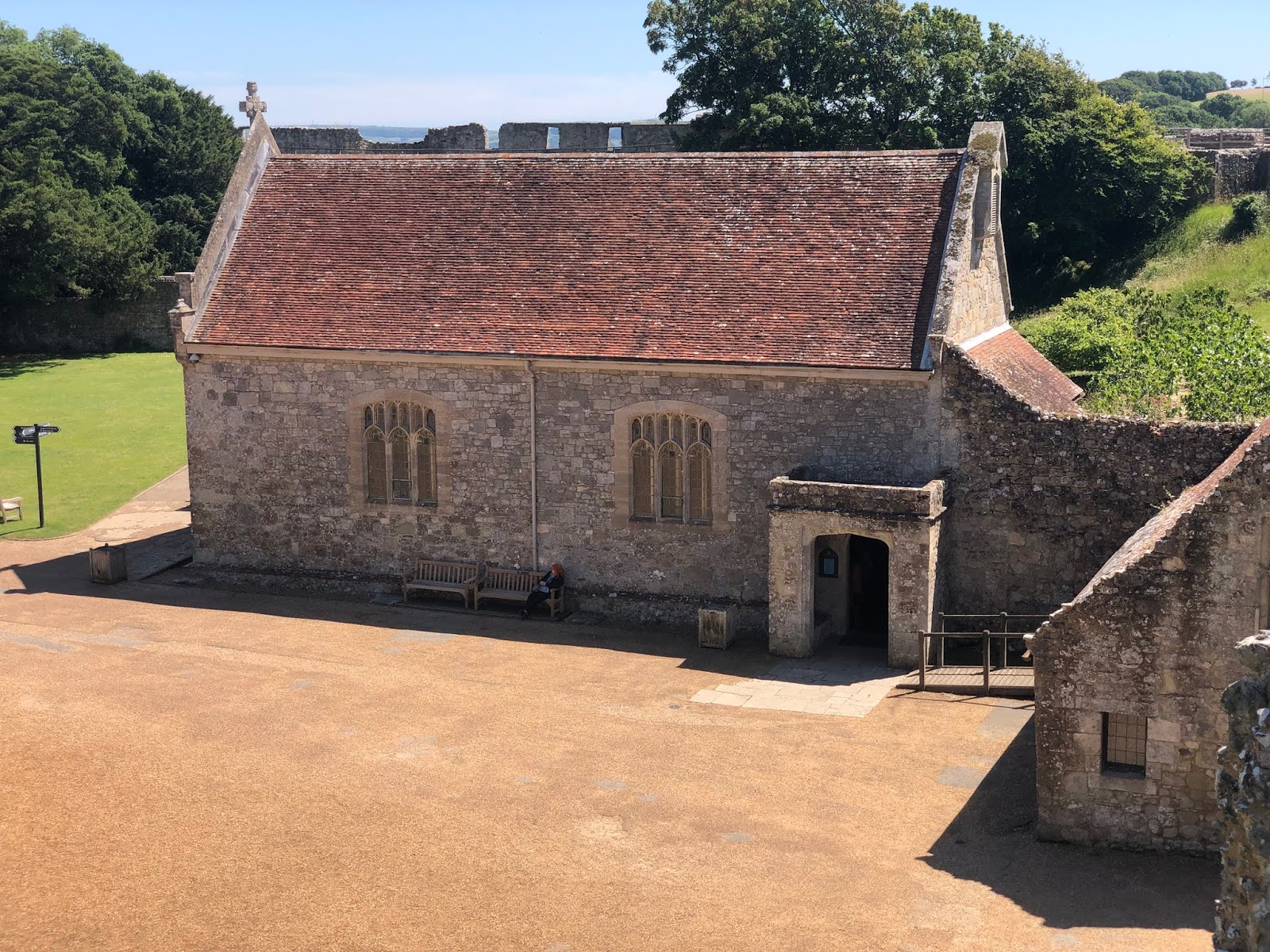
Carisbrooke Castle Chapel.

The altar of the Carisbrooke Castle Chapel.

The fireplace in gatehouse of Carisbrooke Castle.

The Needles
The Needles is a row of three stacks of chalk that rise about 30m out of the sea off the western extremity of the Isle of Wight. The Needles Lighthouse, built in 1859, stands at the outer, western end of the formation.  The formation takes its name from a fourth needle-shaped pillar called Lot's Wife, which collapsed in a storm in 1764. The remaining rocks are not at all needle-like, but the name has stuck.


Sister Burkinshaw along the path that leads to the Needles.  The coast is sandstone and does not show chalk formations.

Our first view of the Needles chalk formations.

Elder and Sister Burkinshaw at the observation deck for the Needles.  You can see the lighthouse at the far end of the 3rd formation.  You can see the gap where the fourth formation which was reportedly in the shape of a needle and was called Lot's wife.

The Needles from Isaac Taylor's "one inch map" of Hampshire, published in 1759, showing Lot's Wife, the needle-shaped pillar that collapsed in a storm in 1764.

A close-up of the Needles formation.  Note that the point of the coast finally shows the chalk cliffs which are so familiar along the southern coast of England such as Eastbourne and Dover.

We conclude with some training we recently provided to the Temple Ordinance Workers in the London Temple, which is pertinent to our times.


Embracing Change in Our Temple Service
London Temple, Thursday, June 13, 2019
Stacey:  Dear Brothers and Sisters, our previous message was how we could apply the principle of non-distraction in our temple service and thereby bless the lives of our patrons.  Today, we would like to share some thoughts on embracing change in our temple service so we may likewise bless the lives of our patrons and our fellow temple workers.


Jeff:  Adapting to change is generally not easy. It requires effort.  President Eyring, drawing on his undergraduate training as a physicist has said, “Most of us believe in the law of conservation of energy, particularly our own.” (“A Law of Increasing Returns”, BYU Devotional, March 28, 1982)   Resistance to change is not new.
Stacey:  The Savior said to those who criticized his disciples for doing things differently, “And no man putteth new wine into old bottles; else the new wine will burst the bottles, and be spilled, and the bottles shall perish. … No man also having drunk old wine straightway desireth new: for he saith, The old is better. (Luke 5:37, 39)  In other words, the critics will always say “The old way we did things is better.”
Jeff:  The Prophet Joseph Smith said, “I have tried for a number of years to get the minds of the Saints prepared to receive the things of God; but we frequently see some of them, after suffering all they have for the work of God, will fly to pieces like glass as soon as anything comes that is contrary to their traditions: they cannot stand the fire at all. How many will be able to abide a celestial law, and go through and receive their exaltation, I am unable to say, as many are called, but few are chosen [see D&C 121:40].” (Teachings of the Presidents of the Church: Joseph Smith, Chapter 45, p 520)
Stacey:  And now consider the messages we are receiving today from our Prophet.  And the mode of his communication further underscores the magnitude of the change!  President Russell M Nelson has tweeted, “We are witnesses to the process of restoration. If you think the Church is fully restored, you’re just seeing the beginning. There’s much more to come. Wait until next year, and then the next year. Eat your vitamins, get your rest. It’s going to be exciting!” (Twitter, @NelsonRussellM, 1 Nov 2018, 3:01pm)
Jeff:  We are all witnesses to the changes in policies, procedures, schedules and ordinances during the past 18 months.  Note that for the Temple, the Brethren provide general guidance (“uniformity but not rigidity” from Temple Administration Training Video) and then the Temple President, his Counselors, the Matron and her Assistants are responsible to implement the specific changes (“best left to the Temple Presidency”).  For example, the Temple Presidency regularly shares information from the Temple Presidents Handbook and other correspondence and then they provide even more specific direction on implementation in the Administrative Guidelines for the London Temple.  Both are important.  How then can we embrace change in our temple service?
Stacey:  First, out of our love for the Lord and our patrons, we can make sure that we understand our duties.  This may require extra effort, such as study outside of our regularly scheduled work shift but that love-inspired determination will yield great blessings.  We have three types of training materials we can use to learn our duties here in the Temple.
Training Films:  There are 24 training films which we see regularly in our preparation meetings.  When workers are trained in new roles, the films are also used for instruction.
Jeff:  Ordinance Instruction Cards:  Last year, 9 Ordinance Instruction Cards (about 30 pages) were introduced.  These cards summarize what is taught in many of the training films.  Each coordinator (Initiatory, Name Issue, Veil, Baptistry and Sealing) has copies of those cards in their packet of sacred cards.  They can also be checked out of the office from the Assistant Recorders.  The Assistant Shift Coordinators also have copies of the Ordinance Instruction Cards.
Stacey:  London Temple Administrative Guidelines:  There are 20 Administrative Guidelines for the London Temple which describe each of the roles we may serve in as Temple Ordinance Workers.  Laminated copies of pertinent Administrative Guidelines are also in the coordinator packets as well as at the Recommend Desk.  The Shift Coordinators and Assistant Shift Coordinators also have a complete set of the Administrative Guidelines.  An important addendum to the Administrative Guidelines is a list of Confidential Updates for the past 18 months.
Jeff:  Second, we need to closely follow the instruction we receive in these materials.  We, on occasion, see workers who do not follow the instruction received, sometimes out of unfamiliarity but sometimes because they think they have a better way (than the Brethren or the Presidency).  Remember, change is not easy and it takes effort to both learn and obey the instruction we receive.  Love should be our motivation and the Savior is our example, “Thy will not mine be done.”  We may not understand the reason behind every change, but we are always blessed for our obedience.  And, by the way, for those who will be here past October, there may be additional opportunities to apply this counsel with a new Temple Presidency.
Stacey:  Here are a few areas where we may seek to improve:
Baptistry:  Number of Ordinances Performed
Adhering to Scheduled appointments: “Temple workers strive to accommodate all who come to the temple baptistery. Patrons who schedule appointments are accommodated, as much as possible, at their scheduled time. Patrons without an appointment are made to feel welcome and are accommodated in a kind manner, but those with scheduled appointments are given priority.
The Presidency has provided guidance that a group can complete about 80 baptisms and confirmations per hour.  Thus, a 1½ hour baptistry could complete 120 cards if they are on time (arrive 30 minutes before their session is scheduled to start) and have adequate help, 8 priesthood holders-four of which are endowed.  As the Presidency has said, it’s not about the numbers, so please help the patrons focus on the Spirit and the people not the numbers. (In the middle of May Jeff and I began the work for the Shapland Family in the baptistry – Arthur, Frank, Frederick, William, Gertrude, Annie, Lilly, Nellie, Eva, Lucy were all sealed to their parents are now a “forever family”.  Did you count the number or listen to the names?
Jeff:  Caring for Sacred Cards:  The Brethren have asked us to develop a concern for the sacred cards.  If you have sacred cards in a notebook, such as a veil coordinator, do not set them down.  Either hold them or lock them in a secure location.
Stacey:  Patrons with Disabilities: From the Ordinance instruction card “Accommodations are made to allow patrons with disabilities to participate in the initiatory ordinances….Under the direction of the temple presidency, it is also permissible to perform all segments of the initiatory ordinances in one compartment.”
Jeff:  2 Nephi 28:30 “For behold, thus saith the Lord God: I will give unto the children of men line upon line, precept upon precept, here a little and there a little; and blessed are those who hearken unto my precepts, and lend an ear unto my counsel, for they shall learn wisdom; for unto him that receiveth I will give more; and from them that shall say, We have enough, from them shall be taken away even that which they have.” (Obedience to that which we understand provides opportunity for growth and more learning-obedience is the path to understanding and to knowledge.)

Stacey:  Brothers and Sisters, the overall principle for today is stated in D&C 105:37 “And inasmuch as they follow the counsel which they receive, they shall have power after many days to accomplish all things pertaining to Zion.” 
In the name of Jesus Christ, Amen.

Elder and Sister Burkinshaw