Thursday, November 1, 2018

October 1-31, 2018 - Autumn, Basildon Park, Eltham and Hampton Court Palaces

October has definitely been a month of transition as the London Temple reopened and we said goodbye to daylight savings time (which happens in the UK one week before the US) and the weather changed from an unusually warm Summer to a brisk and colorful Autumn (Fall is not used as a descriptor of the season).

This is what the temple looks like in the early morning hours when we walk before our shift.


The London Temple with the harvest moon.


The London Temple with reflecting pond and beautiful autumn colors.

Autumn foliage on the London Temple grounds.

Colors around the temple patron accommodation center.

The Fall colors on the grounds of the London Temple.


After an unusual (this year) rainy morning, we saw a beautiful rainbow behind our flat in the Lodge. This was taken from our living room window.

Standen House, just a few miles from the Temple, also has beautiful autumn colors and delicious homemade bread and tomato basil soup, if your there on the right day. 

Basildon Park

On our off-Monday, we visited Basildon Park which is about 70 miles northwest (90 minute drive) from the Temple which is about half-way to Bath. 

Basildon Park is a country home/estate built in 1776 designed by John Carr in the Palladian style.  It was owned by several families and, during World War I, it was requisitioned by the British government as a convalescent hospital for wounded soldiers.  During World War II it was again requisitioned and served as a barracks, a training ground for tanks, and finally a prisoner of war camp.  By 1952, the once opulent home was in such bad condition that it was slated to be torn down.  However, Lord Edward Langton Iliffe, 2nd Baron Iliffe and his wife Charlotte Gilding, Lady Iliffe, saw potential in the home and using materials from other estates which were to be demolished, they restored the home.  The Iliffe's were childless and gave the estate to National Trust who owns and maintains it today.    

The Palladian-style Basildon Park home with it's north (left) and south (right) pavilions.


The Entrance Hall of the Basildon Park estate.


Lord Iliffe's library in Basildon Park, designed as the "masculine" room of the estate.

The Basildon Octagon room with original mirror but drapes and wall coverings "repurposed" from Blenheim Palace.

The Basildon Park Dining Room, redone by Lord and Lady Iliffe since many of the original furnishings had been sold to the Waldorf Astoria hotel in 1929 by the previous owner.

The "Basildon Room" in the Waldorf Astoria Hotel, New York City.  It contains the original fireplace, mirrors and wall and ceiling paintings from the Dining Room of Basildon Park.  


The grand stairway (note the cantilevered steps) with Sister and Elder McQuivey who accompanied us on this visit to Basildon Park.

Sister Burkinshaw was invited to play the piano in the grand stairway room of Basildon Park.

One of the most unique rooms in Basildon Park wash the Shell room, decorated with various shells that Lord and Lady Iliffe collected during their world travels.

A close-up of one of the cabinets in the shell room.

The neoclassic east front to Basildon Park as opposed to the Palladin-design on the opposite side.

Eltham Palace

Eltham Palace, located in southeast London, was originally occupied by King Edward III and it was here that the inspiration for the Most Royal Order of the Garter (see Windsor Palace post) occurred.  This was also one of the places where young prince Henry VIII grew up and where he was first introduced to Sir Thomas More who became one of his councilors.  With the rebuilding of Greenwich Palace closer to London's center, Eltham Palace became less frequented and by the late 1890's had fallen into total ruin.  The current home, which connects to the original great hall, was built in 1933 by Stephen Courtauld and his wife Virginia "Ginie" Courtauld.  They lived there until near the end of World War II and then gave the palace to the Royal Army Educational Corps and today it is managed by National Trust. 


Sister Burkinshaw welcomes us to the north side of Eltham Palace which is the newer (1933) side of the house.


A panoramic view of Eltham Palace with the "Great Hall" of the original palace on the right.
Eltham Palace from the south side showing the new house on the right with the "Great Hall" on the left.
Sister Burkinshaw in the sunken gardens on the west side of Eltham Palace where the "Great Hall" is visible.  

More of the sunken gardens.
Some of the remaining fall flowers in the garden.

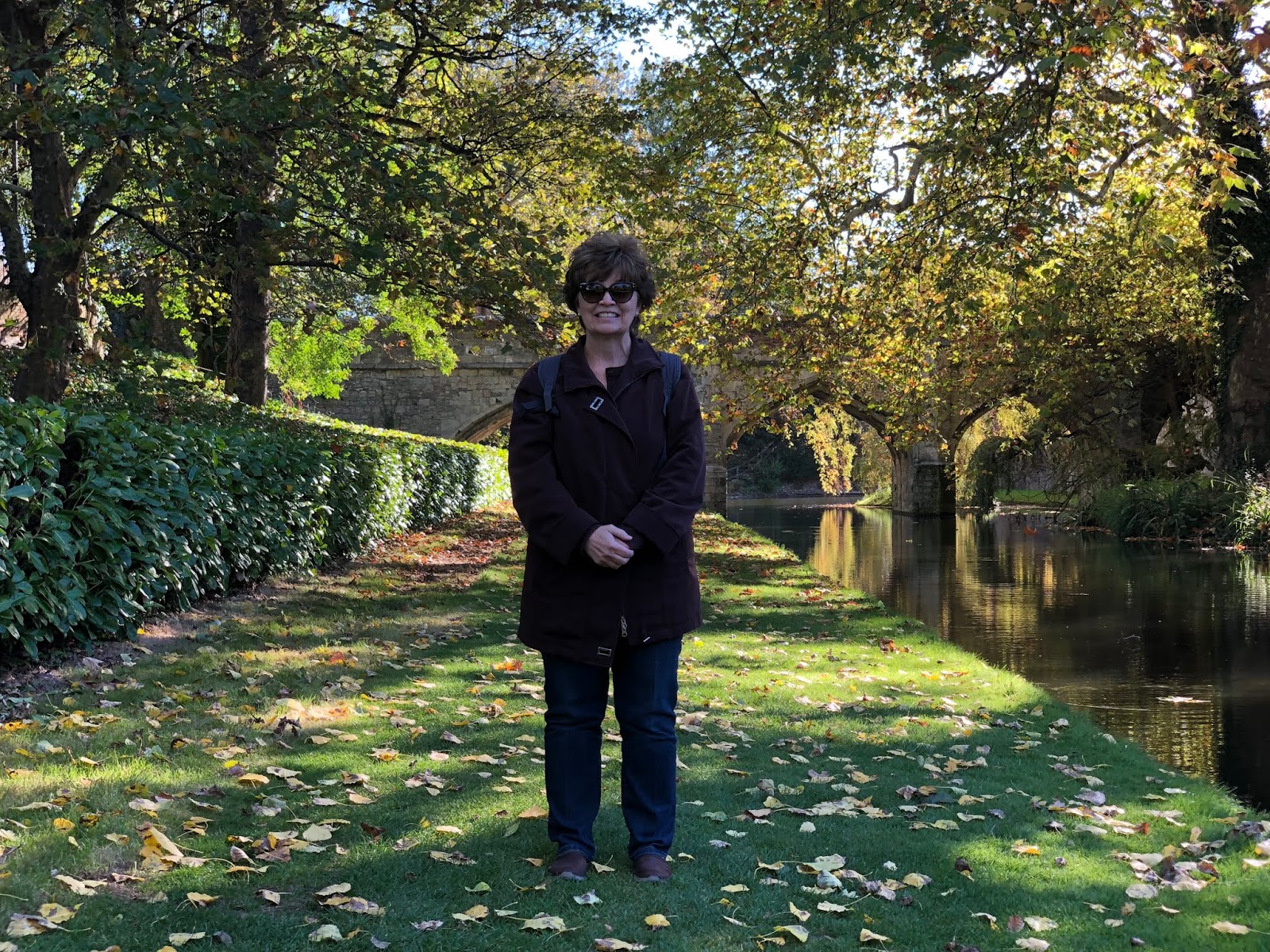
Sister Burkinshaw in front of the 15th century bridge across the moat on the beautiful grounds of Eltham Palace.
Close-up of the 15th century bridge across the moat.

The Great Hall was restored in 1933 and it is now used for weddings and other receptions. The son of one of the couples working at the London Temple had his civil marriage here before being sealed in the Temple.

An outside view of the Great Hall from the front of the Palace.
Sister Burkinshaw's favorite room at Eltham Palace, the sun room.
Hampton Court Palace 

Hampton Court Palace is 12 miles south west of central London on the River Thames.  The original palace was built by Cardinal Thomas Wolsey until he fell out of favor with King Henry VIII in 1529. Henry VIII later enlarged it along with other later kings.  Today, the palace is open to the public and is a major tourist attraction.  The palace served as the location for the film A Man for All Seasons (1966). It also appeared in the miniseries John Adams (2008) where Adams was received by King George III as the first U.S. Ambassador to the Court of St James's. The palace was used in the film To Kill a King (2003), Pirates of the Caribbean: On Stranger Tides (2011) and in Sherlock Holmes: A Game of Shadows (2011). The palace also served as a location for the live action film of Disney's Cinderella (2015), directed by Kenneth Branagh and starring Lily James and Richard Madden.


Ariel view of Hampton Court Palace.


Sister Burkinshaw standing in front of Hampton Court Palace.


Sister Burkinshaw in the Courtyard, the barrels covered speakers that had sounds and conversations that would have been taking place during Henry VIII's day.


Inner Court and fountain of Hampton Court Palace.


King Henry VIII commissioned the Story of Abraham Series of tapestries in 1540 to commemorate the birth of his male heir, Prince Edward from his third wife, Jane Seymour, who died of complications associated with the birth.  The tapestries were of astonishing value (£2,000 in 1540 which today would be worth over £20,000,000) but their worth was not purely financial. Henry VIII may have framed Abraham's story as similar to his own political and religious situation.  Tapestries were the most elegant form of art at the time.


Sister Burkinshaw in the Great Hall of Hampton Court Castle where the Abraham Tapestries, commemorating events in the life of Father Abraham, are hung.  You can see how large (16 ft x 25 ft) and therefore heavy they are.  The pigments have faded over the nearly 500 years since they were created but the artwork is still amazing.

Tapestry of Abraham's Purchase of the Field of Ephron.

Tapestry of the return of Sarah.

Tapestry of God appearing to Abraham.

Tapestry of the circumcision of Isaac and the expulsion of Hagar.

Tapestry of Eliezer and Rebekah at the well.

Tapestry of the departure of Abraham.

Tapestry of the separation of Abraham and Lot,

Tapestry of the oath and departure of Eliezer.

Tapestry of the sacrifice of Isaac.

Tapestry of the meeting of Abraham and Melchizedek.


Stained glass in the Great Watching Chamber of Hampton Court Castle.

Henry VIII (1491–1547) became King of England in 1509. He started out as a good monarch, sensible, reasonable and pleasant, but later his behavior changed drastically. He became irascible, intolerant, violent and tyrannical. In January 1536, Henry had a serious jousting accident and was unconscious for 2 h. It is generally believed that this accident played a major role in his personality change. Letters of that time, however, indicate that the change began insidiously in 1534 and became most drastic in 1535, a year before the accident. Henry had suffered from leg ulcers before and after the accident and had been constantly treated for them for many years. Prescriptions for the medications used to treat these ulcers contained a high proportion of lead in various forms. Lead can be absorbed through skin, especially damaged skin. Absorbed lead can affect the brain, causing psychiatric problems, especially those associated with violence. One hypothesis is that  absorbed lead from his medications were a major factor in King Henry’s personality change.


In 1534, Henry VIII declared himself Supreme Head of the Church of England.  He believed that he had direct and privileged access to God and the Pope was therefore unnecessary.  Henry justified this through his reading of the Bible, as we can see in this brutal painting that Henry commissioned where the four writers of the Gospels are crushing the Pope with rocks.


The Women's Bathroom complete with bathtub shown in the the middle.

The Men's bathroom with no tub but lots of cologne.

This was King Edward III's toilet, which one might call "The Royal Throne." ;-)

These are folded cloth napkins, prepared for entertaining those you wished to impress.

Private Royal Dining Room at Hampton Court Palace.

Weapons such as pistols, rifles and knives were used to create decorations on the walls.


This is the chocolate room where Thomas Tosier, chocolate maker to King George I (1714-1727) and King George II (1727-1760), put the final touches to the King's chocolate drink.  Chocolate was a luxury, far more expensive than tea or coffee.  It was laced with exotic spices, served in gold and silver chocolate pots and drunk from porcelain cups. 

The fountains in east front of Hampton Court Palace 


Elder and Sister Burkinshaw with the reflecting pool and River Thames in the background.

The palaces and castles of England have been very interesting and have provided thought-provoking insights into the history of western civilization.  However, as we have served in the temple, the language of kingdoms and thrones and power points beyond this mortal life.

President Russell M Nelson has said,

"Brethren and sisters, material possessions and honors of the world do not endure. But your union as wife, husband, and family can. The only duration of family life that satisfies the loftiest longings of the human soul is forever. No sacrifice is too great to have the blessings of an eternal marriage. To qualify, one needs only to deny oneself of ungodliness and honor the ordinances of the temple. By making and keeping sacred temple covenants, we evidence our love for God, for our companion, and our real regard for our posterity—even those yet unborn. Our family is the focus of our greatest work and joy in this life; so will it be throughout all eternity, when we can 'inherit thrones, kingdoms, principalities, … powers, dominions, … exaltation and glory.'" (Russell M Nelson, “Set in Order Thy House”, GC October 2001)

Elder and Sister Burkinshaw

Monday, October 1, 2018

September 28-30, 2018 - Bath

During the final week of the London Temple shut-down, we worked cleaning up the Temple Grounds and for the weekend, we drove to Bath which was aptly named because of its mineral hot springs where the Romans built spas or medicinal baths which were believed to cure a variety of physical ailments.  In 1987, Bath was named a World Heritage Site by UNESCO (United Nations Educational, Scientific and Cultural Organization) which means it is important to the "collective interests of humanity" and the UN provides funding to preserve the site.  The Bath economy relies primarily on tourism but also has software and publishing industries as well as two universities.  Jane Austen also lived in Bath during the early 19th Century and many of her novels describe the sites and lifestyle of the city.  More importantly to our family, Bath is the hometown of Abraham Marchant and his father Abraham Marchant who are Sister Burkinshaw's 3rd and 4th Great Grandfathers respectively.

Roman Baths and Abbey


Sister Burkinshaw in front of the Cross Bath.  The Cross Bath on Bath Street, Bath, Somerset, England is a historic pool for bathing.  The water which bubbles up from the ground at Bath, fell as rain on the nearby Mendip Hills. It percolates through limestone aquifers to a depth of 14,100 ft where geothermal energy raises the water temperature to between 150-250 °F. Under pressure, the heated water rises to the surface along fissures in the limestone.

Kings and Queens Bath.  From ancient times, the baths were believed to have special curative powers and were sought to relieve a sundry  of physical ailments.  Thus the Royals established a residence here in Bath to take advantage of this unique resource.

Royal Mineral Water Hospital was founded in 1738 to provide care for the impoverished sick who were attracted to Bath because of the supposed healing properties of the mineral water from the spa.  Today it is an NHS (National Health System) facility specializing in Rheumatic Disease and Rehabilitation for adults, adolescents and children

Bath Abbey which was founded in the 7th century and the current building was constructed in the 16th century.  The Abbey as well as most of the buildings in Bath are constructed from "bathstone" which is a unique golden honey-colored limestone which can be squared (sawed or cut) in any direction.  Unfortunately it is quite porous and both weathers and eventually crumbles as well as having a propensity to mildew and therefore requires regular cleaning (as can be seen in the Royal Mineral Water Hospital) 

Sister Burkinshaw in front of the entrance to the Bath Abbey.

The Bath Abbey from the back, as seen from the Avon River.


We took a boat ride along the Avon River.  Avon is a Celtic word for River so Avon River is redundant! ;-)  The Empire hotel is in the center and was designed to represent the three classes of people.  The corner was designed to look like a castle representing royalty, the center was designed to look like an estate home representing the aristocracy and the far corner looked like a cottage (or cottages) representing the common folks.  To the right is the Pulteney Bridge constructed in 1774.  It was a beautiful, sunny day.

Sister and Elder Burkinshaw from the boat with the River Avon in the background.  By the way, this is a different River Avon than runs through Stratford where Shakespeare lived.

Jane Austen


The Prince of Wales monument in the Queens Square, near the Jane Austen Centre.

The Jane Austen Centre features a permanent exhibition that tells the story of Bath's most famous resident, the author Jane Austen. It explores the effect that living in the Georgian city had on her life and writing.

Sister Burkinshaw with a life-sized model of one of her favorite authors, Jane Austen.

Since Bath was very crowded on the Saturday we were there, we arranged to spend the night at the Tracy Park Country Club in the adjacent village of Wick.  Tracy Park was an estate documented from Roman times and was privately owned until 1973 when it become a golf and country club and hotel.

  
Tracy Park Country Club


This is the Tracy Park Restaurant and was built as part of a private estate in the 18th century.  You will note it was built with bath stone (limestone quarried near Bath) as much of it has become dark with mildew.  It is a very impressive building.

An inside view of the Tracy Park Golf and Country Club restaurant.  The windows on the left look out on to the golf course.


Elder Burkinshaw having his buffet breakfast at the Tracy Park Golf and Country Club restaurant.  It was excellent and included hot chocolate as it was a very cool, crisp morning.

"Cleanliness is next to Godliness" is a phrase first recorded in a sermon by John Wesley in 1778, but the idea is ancient, found in Babylonian and Hebrew religious writings.

Our hotel cottage just adjacent to the restaurant at Tracy Park Golf and Country Club.

Sculptures with driftwood are very popular here in the UK.  At Tracy Park Golf and Country Club, they had this elephant and two giraffes near our hotel cottage.

We attended Sunday meetings at the Bath Ward where we saw many people who are regular patrons of the London Temple and several former temple workers and their families.


Abraham Marchant

Bath is the hometown of Abraham Marchant and his son Abraham Marchant who are Sister Burkinshaw's 4th and 3rd Great Grandfathers respectively.

Family pedigree chart showing the Marchant Line in yellow.
Sister Burkinshaw pointing at the New Marchant Passageway which was named after Abraham Marchant, the firefighter who died saving a young servant girl.  

Sister Burkinshaw standing in the New Marchant Passageway.
While we were in Bath, we looked for the grave of Abraham Marchant who died in 1815.  FamilySearch has listed that he was buried at Smallcombe Vale Cemetery.  We were unable to find Smallcombe Vale Cemetery but we did find Smallcombe Garden Cemetery.


Layout of the Smallcombe Garden Cemetery where Abraham Marchant might have been buried. Since the cemetery was not officially opened until 1856 and Abraham Marchant was buried in 1815, it's unlikely he was buried here.  We spent the afternoon looking at the headstones but did not find any before the 1850's.  However, it's not possible to verify that he wasn't buried here because many of the headstones are unreadable.

Picture of the chapel in the Smallcombe Garden cemetery.

Headstones in the Smallcombe Garden cemetery Bath, UK.


As we were assigned the spiritual thought for Preparation Meeting following our trip to Bath I shared a little about the Marchant line from Bath, UK and the sacrifices they made.


One More Day
Spiritual Thought by Sister Stacey Burkinshaw
Wednesday, October 3 2018 - London Temple Preparation Meeting


Elder Godoy says, “If we were told we had a short time to live, we too might plead for more days of life in the name of things we should have done or done differently.
“Regardless of the time the Lord, in His wisdom, determines to grant each of us, of one thing we can be sure: we all have a “today” to live, and the key to making our day successful is to be willing to sacrifice. In other words, if we will offer to the Lord the sacrifice of a broken heart and a contrite spirit (or as Elder Christoffersen has taught a repentant heart and an obedient spirit), immediately the blessings of the great plan of happiness are manifest in our lives.” (Taylor G. Godoy, “One More Day,” GC April 2018)

“In what ways will sacrifice make our days meaningful and blessed?” Elder Godoy speaks of three: personal sacrifice, sacrifices made for others and the sacrifice of the Son of God.

First, personal sacrifice Elder Godoy tells us, “strengthens us and gives value to the things we sacrifice for.” I know you feel the truth of these words in your sacrifice to serve here in the London temple. Elder Robert D. Hales speaking to Senior Missionaries in the April 2005 General Conference said, “His work….needs what you are uniquely prepared to give. Every missionary experience requires faith, sacrifice and service, and these are always followed by an outpouring of blessings.” (Robert D. Hales, "Couple Missionaries:Blessings from Sacrifice and Service," GC April 2005)

Second, Elder Godoy teaches, “sacrifices we make for others, and that others make for us, result in blessings for all.” Jeff and I felt this many times the past month as we visited family sites here in Europe and read again the histories of our own ancestors. Last week we visited Bath where 6 generations (we have records for) of my Marchant line, maternal grandmother’s line, lived and worked. There is a small covered street, the “new Marchant passageway” in the downtown mall area which was named after my 4th great grandfather who was a firefighter in Bath and gave his life saving a young servant girl from a burning building. With this sacrifice he left a wife and seven children without a provider. The 8th child, Abraham Marchant, was born 7 months later and named after a father he would never know. This 3rd great grandfather lived, married, worked and joined the Church in Bath and then immigrated to Utah in response to the call of a prophet. The church was blessed by the sacrifice and service of this good family both in Bath and in Utah and Wyoming, but most especially their posterity has been blessed.

Third, Elder Godoy reminds and then teaches us, “….any sacrifice we make is small compared to the sacrifice of the Son of God. He then teaches, “What is the value of even a beloved gold bracelet compared to the sacrifice of the very Son of God? How can we honor that infinite sacrifice? Each day we can remember that we have one more day to live and be faithful.”

“In other words we will be more willing every ‘one more day’ to follow the invitation that President Howard W. Hunter extended to us when he said: “Mend a quarrel. Seek out a forgotten friend. Dismiss suspicion and replace it with trust. … Give a soft answer. Encourage youth. Manifest your loyalty in word and deed. Keep a promise. Forgo a grudge. Forgive an enemy. Apologize. Try to understand. Examine your demands on others. Think first of someone else. Be kind. Be gentle. Laugh a little more. Express your gratitude. Welcome a stranger. Gladden the heart of a child. … Speak your love and then speak it again” (Teachings of Presidents of the Church: Howard W. Hunter [2015], 32).  In the name of Jesus Christ, Amen. (End of spiritual thought)

We are so grateful for the continued opportunity to serve here in the London Temple, although it doesn't seem like much of a sacrifice to us, we are mindful of the blessings we have received personally and that we see manifest in the lives of our family. 

Elder and Sister Burkinshaw